
By the time he started school a year later, that boy understood Arabic. Not because anyone had taught him — because he had watched, listened, and let the sounds arrange themselves into meaning. He had no idea, at five, that this was unusual. He thought this was simply how language worked.
It took him thirty years to understand what had actually happened — and to build a platform around it.
A childhood in languages
Sabur grew up in a small mountain village. The family's first television received one channel clearly: a Baghdad broadcast in Arabic. With no way to understand what anyone was saying, he did what any child does in front of a screen — he watched, repeatedly, until the patterns became familiar. Until the sounds attached themselves to images. Until he stopped needing to understand and simply began to know.
Persian came next, not through television but through school. He was six. The instruction was entirely in Persian. He absorbed it the same way he had absorbed Arabic: through immersion so complete that there was no alternative. He didn't acquire Persian consciously. He was surrounded by it until it became natural.
Arabic
Baghdad TV. No subtitles, no teacher. Pure immersion through a screen that nobody in the village understood.
Persian
School immersion. A language absorbed through necessity, not instruction.
Azerbaijani
The family relocated to a city where Azerbaijani was dominant. He learned it in the courtyard, from the neighbourhood kids, because there was no other way to play.
Turkish
Watching popular Turkish drama series with his sisters. Matching vocal tone to facial expression, scene by scene, until the meaning arrived without translation.
English & German
Engineering documentation required English. German came through private tutors — his first structured experience of language learning, and the first time it felt slower than it should.
Chinese & Polish
Sprint-style experiments in multiple methods: audio courses, story-based programmes, conversation with native speakers. Each confirmed the same pattern.
Azerbaijani arrived at thirteen. His family moved to a city where the neighbourhood spoke almost exclusively Azerbaijani Turkic. Within a few months, he was playing in the courtyard with the local kids and conducting himself entirely in a language he had not known existed two seasons earlier. He learned it the way he had learned everything else — because the social environment demanded it, and because children adapt before they realise they are adapting.
Turkish came differently, and perhaps most revealingly. There was no social pressure, no courtyard, no immersive necessity. He watched Turkish television dramas with his sisters — the serialised melodramas that sweep across the Middle East and Central Asia, watched by millions who feel the emotional weight of scenes they can barely follow. He matched vocal tone to facial expression. He let the recurring characters build a vocabulary he never deliberately studied. Within a year, he understood Turkish comfortably. He had never once opened a grammar book.
"Every language felt different on the surface. But the process of acquiring them was always the same. I kept waiting to find a language that required a different approach. I never did."
Sabur · Founder, FunLinguaThe engineer's question
He studied systems and electronics engineering at university. English became his working language — not through conversation, but through the technical documentation of a field that conducts itself almost entirely in English. He read circuit diagrams and software manuals and eventually wrote code. He learned to think in English by thinking about problems that English described. The language was inseparable from the material.
He went on to teach software engineering and IT disciplines, then relocated to Turkey. Later, Russia. He built a life across languages he had never formally studied — and somewhere in that accumulated experience, a question formed that would not leave him alone.
As a software developer who had also spent years teaching, he found himself thinking about both fields simultaneously. Neural networks, at the time, were becoming a serious area of discussion in engineering circles — systems that trained on vast amounts of data, developed internal representations without explicit programming, and produced outputs that felt, to an observer, almost like understanding.
The prefrontal cortex, when forced to compile grammar tables in real time, stalls. That stall — the freeze a language learner feels in the middle of a real conversation — is not a failure of memory or intelligence. It is the wrong system being asked to do the wrong job.
The parallel was impossible to ignore. The brain does not process language by retrieving grammatical rules and applying them consciously. Native speakers do not parse verb conjugation tables before speaking. They produce language the way a neural network produces output — through patterns trained on enormous amounts of real data, operating below the level of conscious reasoning, faster than any deliberate process could manage.
This was not a new insight in academic linguistics. The distinction between declarative and procedural memory, between explicit knowledge and implicit acquisition, had been discussed in language research for decades. But it had never, as far as he could find, been turned into a practical teaching system that applied it rigorously from the first minute of the first lesson.
That became the project. Not a new language school. Not a better textbook. A method that treated language acquisition the way it actually worked — as a process of neural training on real contextual data — and built a teaching system around that single idea.
Dynamic Language Immersion
The DLI method has three pillars, each derived directly from how the brain processes language naturally rather than academically. Real scenes from real media, not scripted dialogues. Shadowing — the practice of echoing native audio a half-second behind the speaker — to train the vocal-motor system before the conscious mind can interfere. And algorithmic spaced repetition, surfacing vocabulary at the precise moment the forgetting curve would otherwise take it.
None of these ideas, individually, were invented at FunLingua. What was built was a coherent, practical system that combined them — and the discipline to resist the temptation to add grammar instruction back in because it felt more like teaching.
The proof he didn't plan
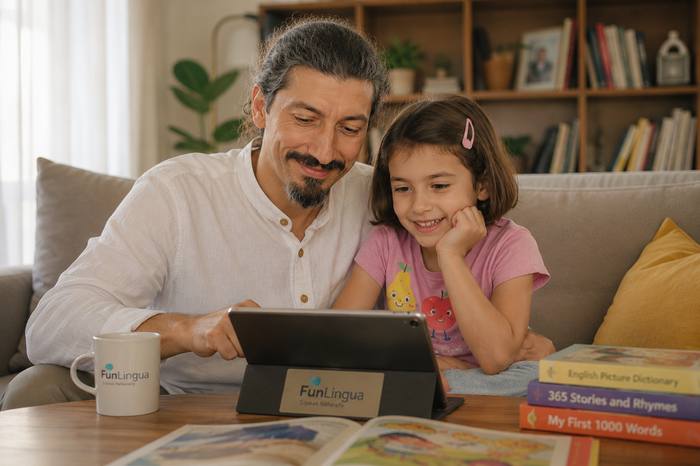
The most persuasive evidence for DLI is not a study or a testimonial. It is a five-year-old who switches between three languages depending on who she is talking to, with no accent in any of them, having never been told that language learning is something you have to try to do.
She has heard Russian, Persian, and English her entire life — in different contexts, from different people, through cartoons and stories and ordinary daily conversation. She was never taught grammar. She was never drilled on vocabulary. She absorbed three linguistic systems the way every human being absorbed their first one: through continuous immersive exposure, beginning before she had the cognitive apparatus to think about what she was doing.
She is now beginning Chinese and Turkish the same way. She is not studying them. She is watching them, listening to them, shadowing the sounds before she knows what the words mean. By the time she is old enough to be asked what her native language is, she may not have a clear answer. That is the point.
Her existence does not prove that DLI works for adult learners who come to a language later in life. Adults are slower; the procedural system is less plastic; deliberate structuring of input is necessary in ways it is not for children. But she proves something equally important: that the underlying mechanism — immersion, pattern absorption, unconscious acquisition through real contextual input — is not a pedagogical theory. It is how language has always been learned by every human being who has ever learned one.
"She didn't learn three languages. She was just always surrounded by them. The question FunLingua asks is: can we create that same condition for adults, deliberately?"
Sabur · Founder, FunLinguaWhy this, and why now
FunLingua is not a business idea that preceded a method. It is a method that accumulated over forty years, and eventually demanded a platform worthy of it. The technical infrastructure — the synchronized classroom, the subtitle system, the spaced repetition engine, the milestone architecture — all of it exists in service of a single pedagogical commitment: that language is not an academic subject, and the moment it is taught like one, the learner has already lost.
The platform is founder-led by design, not by default. Every significant decision — which languages to teach first, how teachers are certified, how pricing is structured, what a lesson looks like — is made by someone who has been on both sides of the process. Who has sat at a kitchen table not understanding a television programme and understood something anyway. Who has watched a daughter switch languages mid-sentence without noticing she had done it.
That is not a marketing position. It is a working hypothesis, tested across ten languages and one lifetime, that language is something human beings are built to do — and that the main obstacle is not difficulty, but method.